
European Turtle-Dove
The European turtle dove (Streptopelia turtur) is a threatened or vulnerable member of the bird family Columbidae, the doves and pigeons. It breeds over a wide area of the south western Palearctic including north Africa but migrates to northern sub-Saharan Africa in winter.
In Türkiye
Arrives in spring and leaves in autumn; winter records are almost absent.
Most records in May–August.
Provinces where it makes up the largest share of bird records.
Adjusted for how many birdwatchers are out each month; the busiest month = 100%.
12,215 records from Türkiye · #87 of 634 species by number of records. Source: GBIF.org (October 2026). All birds of Türkiye
About
The European turtle dove was formally described by the Swedish naturalist Carl Linnaeus in 1758 in the tenth edition of his Systema Naturae. He placed it with all the other pigeons in the genus Columba and coined the binomial name Columba turtur. The specific epithet turtur is the Latin word for a turtle dove. Linnaeus gave the locality as "India". This was an error, and the type locality has been designated as England. The species is now placed in the genus Streptopelia that was introduced in 1855 by the French ornithologist Charles Lucien Bonaparte.
Four subspecies are recognised:
S. t. turtur (Linnaeus, 1758) – Europe, Madeira and the Canary Islands to western Siberia
S. t. arenicola (Hartert, 1894) – Northwest Africa to Iran and western China
S. t. hoggara (Geyr von Schweppenburg, 1916) – Air Massif and Hoggar Mountains (southern Sahara)
S. t.
Text from Wikipedia (CC BY-SA 4.0)
At a glance
The turtle dove, known for its soft purring call, is a migrant whose European numbers have plummeted, making it a conservation priority.
Similar birds
All birds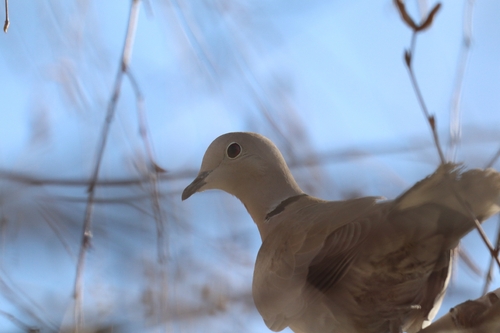


Heard this one in the wild?
Record it and Birdy will confirm — then it's in your journal.