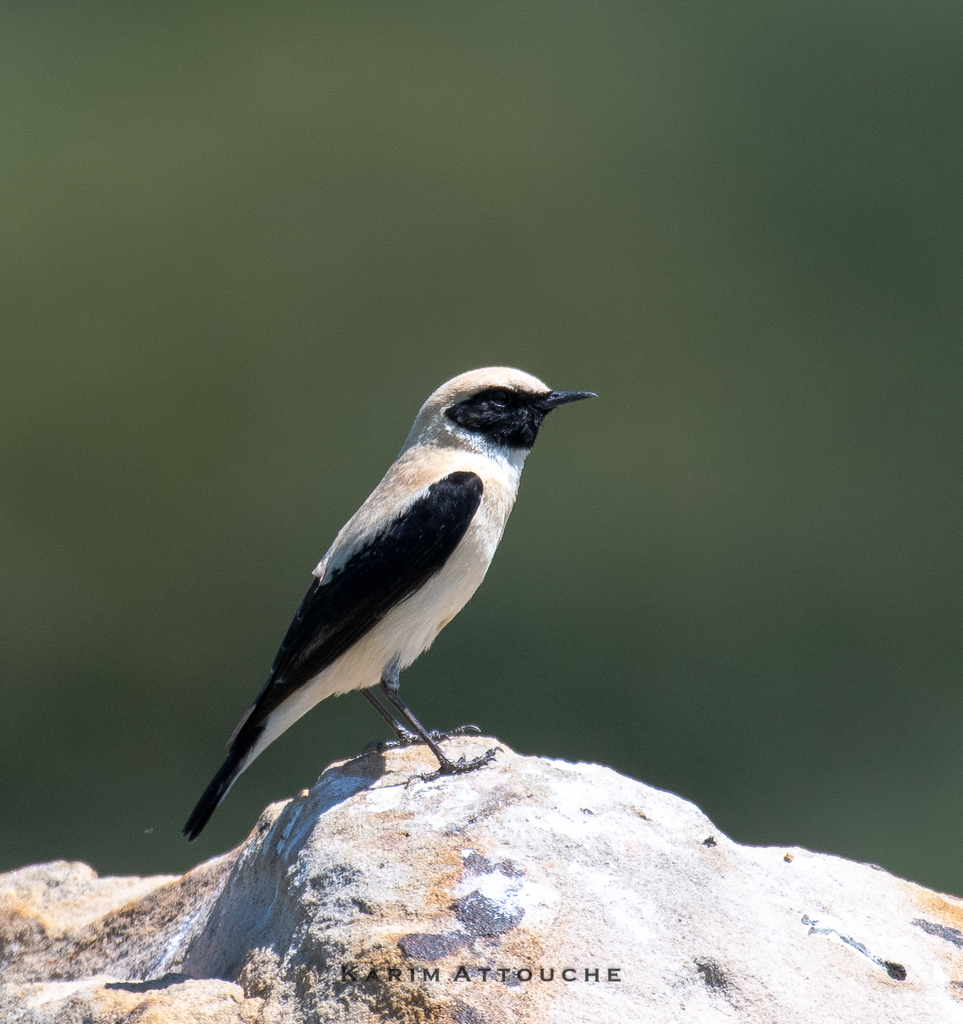
Western Black-eared Wheatear
The western black-eared wheatear (Oenanthe hispanica) is a wheatear, a small migratory passerine bird that was formerly classed as a member of the thrush family Turdidae, but is now considered to be an Old World flycatcher (family Muscicapidae). It was formerly (and still is by some authorities) considered conspecific with the eastern black-eared wheatear.
Hear it on xeno-canto Community recordings — opens xeno-canto →In Türkiye
Arrives in spring and leaves in autumn; winter records are almost absent.
Most records in April–July.
Provinces where it makes up the largest share of bird records.
Adjusted for how many birdwatchers are out each month; the busiest month = 100%.
11,082 records from Türkiye · #96 of 634 species by number of records. Source: GBIF.org (October 2026). All birds of Türkiye
About
The breeding male has the forehead and crown white or nearly white, the mantle buff, and the wings blacker than those of the northern wheatear. The underparts are white tinged with buff. The back, upper tail coverts and most of the tail are white. A black mask extends from the ear coverts to the bill. The throat can be either black or white.
In autumn and winter the head and mantle are distinctly buff, as are the underparts (including the throat in non-black-throated individuals), but the buff varies in intensity. Except for the central pair, the tail feathers are much whiter than in the northern wheatear, the white on the inner web often extending to the tip.
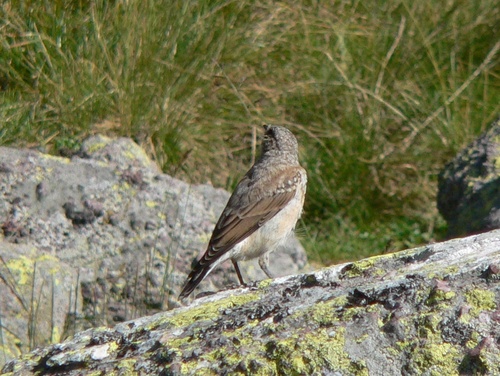
The female is a browner bird, but has the characteristic white lower back, and her seasonal changes are less marked.
Text from Wikipedia (CC BY-SA 4.0)
At a glance
The black-eared wheatear is a wheatear of warm sandy slopes, with two forms whose black mask covers either just the cheeks or the throat.
Similar birds
All birds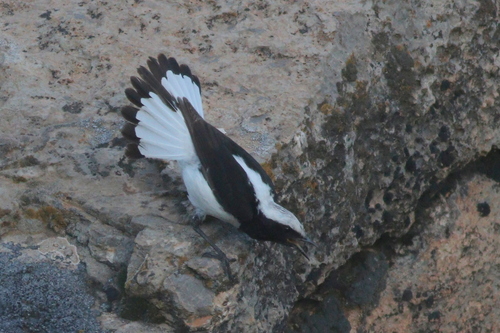
Heard this one in the wild?
Record it and Birdy will confirm — then it's in your journal.